
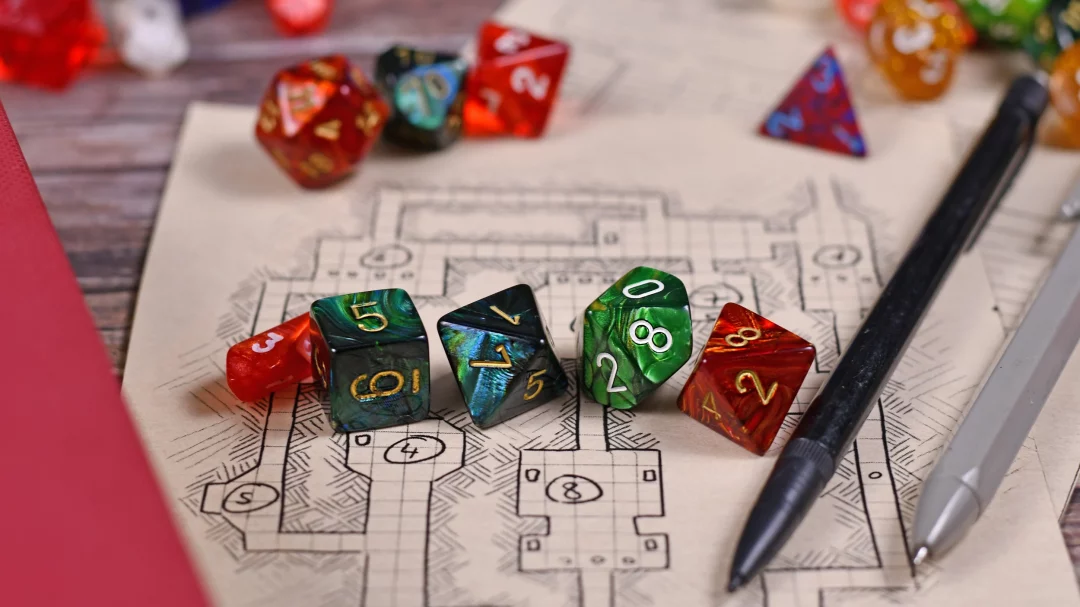
So I thought today might be a good enough time to talk about the game engine I’m thinking of using for my upcoming tabletop roleplaying game. A lot of you will see aspects of what I’m thinking about and scream “That’s PbtA!”… and you won’t be wrong. I’m a huge fan of the “Powered by the Apocalypse” idiom, since there are no real core rules shared among those games, just concepts and some shared ideas here or there.
In reality, I’m borrowing a lot from the core 2d6 concepts of PbtA, with the usual 5 attribute spread (-1/0/1/1/2). The basic game engine is PbtA for sure, using the core 2d6 fail/succeed scale (6 or less is a failure, 7 to 9 is a success with a complication, and 10 or more is a complete success), but other than that… we’re going off of the rails.
So, Moves are going out the window, after a fashion. Rather than using Playbooks with Moves the player then chooses to apply in one way or another, we’ll be using Character Concepts, instead. Basically, the Player will choose a basic Concept for what their character is, then if a situation comes up where the Player feels their character might be able to affect the storyline, they may take an action using whatever of the five Attributes seem to best fit.
The idea is to engage players in the story by asking them to look at their character concepts, imagine what they could reasonably do, and then act upon it. If the player and GameMaster agree that the character should easily be able to accomplish that action, no roll is needed. But if there is some question as to that fact, or if there are consequences that might come into play, then a roll would be asked for. In short, I’m looking to reduce the need to roll dice at all down to basically nothing.
Yes, this is very PbtA/WoD. If you’re going to borrow from anyone, looking at the works of Vincent and Meguey Baker, then John Harper would be the perfect start, no?
So, why do it this way? The idea is to take the adventure and transform it into a conversation. PbtA games are already great at this, with both the GM and players working together to build not just the story, but the world itself. I feel like using Moves makes many players feel like those are the only things they can do, and thus they feel very limited. So I want players thinking about the Character they are building, rather than the Playbook and Moves attached to it.
If that means that some enterprising player can craft a good reason why their Grizzled Old Journalist is also a master of some ancient martial art… Great! Yeah, it may feel like they’re cheating, after a fashion, but again… they have to tell the GM how this character knows these skills. They need to weave a tale as to how this old Journalist studied under some ancient Master in their misspent youth, and perhaps they have continued to practice in private, keeping their skills fresh. The point is, they need to add to the tale being told, one way or another.
Now then, how does one deal with the Mary Sue problem? By which I mean, what if players try to say their characters basically know everything, and can do everything? That’s why there is a GM, and the other players, to be fair. If one player wishes to describe how their character suddenly knows some skill that otherwise hasn’t been a part of their toolset, the GM and/or players can veto it.
As a general rule, I am going to suggest that each character has a primary concept, and its player may add only one previously unknown or new skill once per session. This will rein in players that wish to become a Mary Sue, and perhaps get them to work within the group as a whole, constricting the “need” to constantly add new skills and abilities.
I don’t see this as being a combat-driven game. Yes, it is possible there could be fights, but the point is more to solve mysteries and discover relics. Combat is basically a side situation, best handled quickly and with a quick description by the players of what happened. The action I envision being primary in this game will be escaping from elaborate traps, matching wits with foes, and chase scenes. Think “Indiana Jones”, but with cosmic horrors and cultists.
With that in mind, characters won’t have Hit Points or anything of the like. No Damage Clocks, etc. But there needs to be some mechanic where we can track the “health” of each character, otherwise what creates the tension in the game?
Looking back at the 2D6 mechanic, described above, what happens when a player rolls a 6 or less? The action fails, and the story moves on from there. But what if it didn’t? What if the player could switch that to a success (7-9), or even a complete success (10+), simply by giving the GM a Fate Token?
The GM then keeps track of these tokens, and carries them over from adventure to adventure, until it becomes Dramatically Appropriate to strike down a character? I’m still working on the overall particulars of this portion of the game, when the group itself earns Fate Tokens (probably when they roll a 10+, or do something otherwise completely awesome), and how they would use them. But in the end, what I want is a meta-currency that allows the GM to spend tokens to drop the hammer (when Dramatically Appropriate) on a character, and the Group can spend theirs to maybe advance their characters, or otherwise improve.
Not quite experience points, but advancement just the same. Maybe these Tokens can be used to allow a player to add some ability that their character otherwise didn’t have, or to run a Flashback scene to allow them to bypass a problem facing them (again, thank you John Harper)? But since these points are shared by the group, the group itself has to approve whatever expenditure is asked for.
Again, I’m still pondering how to make this work. But it is coming together, bit by bit.
Anyway, I was going to play test this game as I worked on it, over the actual-play podcast I had been planning to release this month. Oh well, I’ll just have to do it alone or with my wife. But when I get an alpha build for it cobbled together, I’ll release it here for downloading.